
No New State
In 1707 no new parliament was summoned, no new state was born, and the one condition the Union was built to protect was destroyed within a year.

This is the documentary record — in the Anglo-British state’s own hand.
Previously: Her Greedy Sons: A Trope With a Paper Trail, A deep dive into centuries of anti-Scottish tropes - sycophancy/savagery/threat/avarice, and of course our old friend “Sawney Scot”, long before” sweaty socks the original nickname for Scots, designed to suggest savage flesh eating primitivism.
The last piece followed one accusation across three centuries — that Scotland is a drain on England, its greedy sons grown rich at English expense — and found it old, ideological, and incoherent on its own terms. An accusation kept alive that long isn’t incidental, it’s a door held shut. Keep a nation arguing about whether it pays its way and it never reaches the question behind the door. This piece is about the question behind that door.
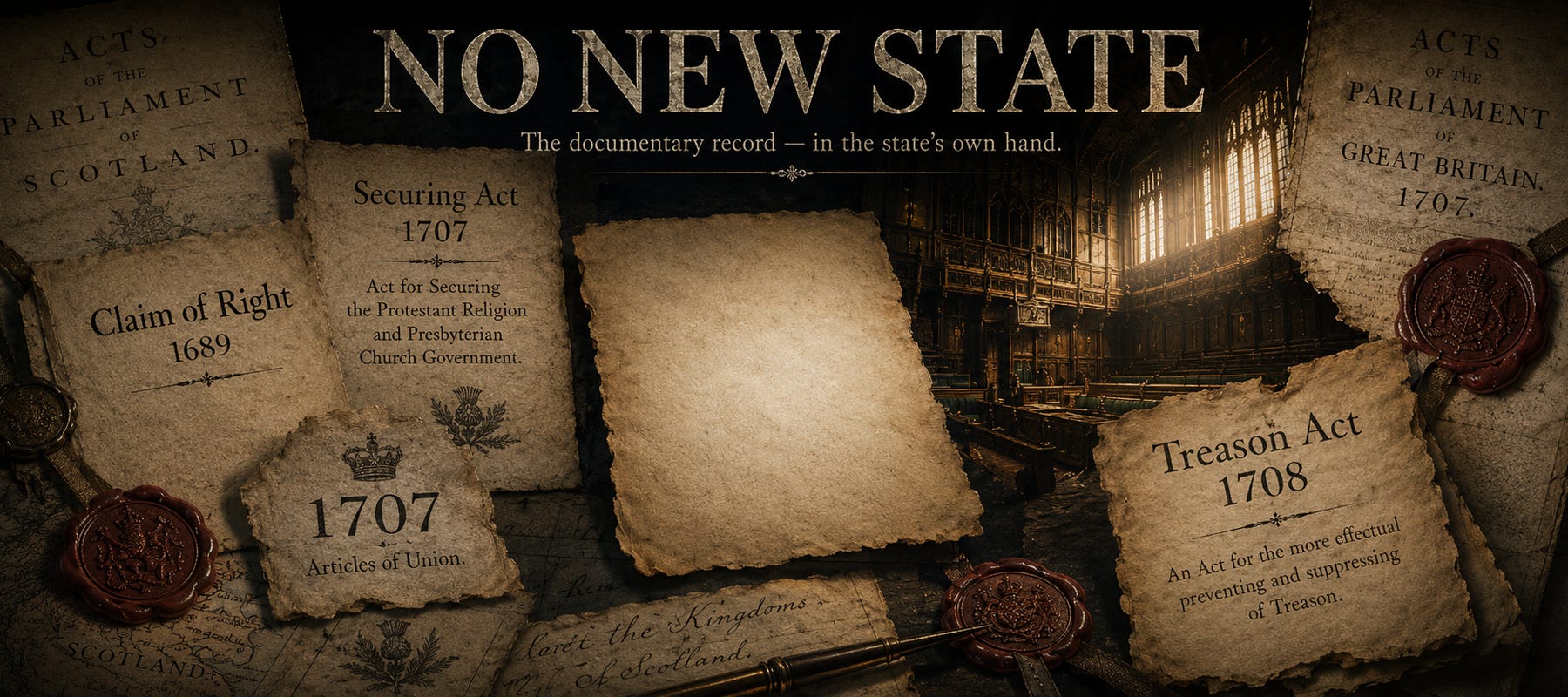
A new state leaves a birth certificate. Somewhere there is a founding instrument, a first sitting of a new body, a moment where one thing ends and another begins and the paperwork says so. When you go looking for that moment in 1707, it’s not there. What you find instead is an English Parliament that carried on, took in a contingent of Scots, and changed its name.
That isn’t the story we’re told though. The story they tell us is of a voluntary union of equals, two kingdoms dissolving into a third, new thing. It’s a tidy story, but the state’s own history, it’s own papers, don’t support it.
The state names itself
The evidence is in the instruments Westminster drafted long after 1707, in the moments where legal precision mattered and rhetoric fell away. There’s a consistent distinction in them. In the narrative — the ceremonial recital, the part addressed to the public — the state calls itself “Great Britain.” In the operative clause, where the law actually bites, it reaches for a different word.
In the British Nationality Act of 1772 (13 Geo. III c. 21), the phrase “Crown of England, or of Great Britain” appears six times inside a single domestic statute. Sixty-five years after the Union, a draftsman with no political reason to make the point treats the two as one institution under two names. In the Union with Ireland Act of 1800, the official designation runs through the preamble while the operative heading names “the Parliaments of England and Ireland.” In the Treaty of Waitangi in 1840, the preamble gives the full title — Queen of the United Kingdom of Great Britain and Ireland — and then every operative article names the contracting sovereign as “the Queen of England.” A domestic nationality statute, a union act, an imperial sovereignty treaty: three unconnected contexts, multiple draftsmen, sixty-eight years apart, and the same pattern each time.
This isn’t a reading imposed on the record, it’s the record’s own evidence, and outside observers noticed it at the time. The Swiss jurist Jean-Louis de Lolme, writing in 1786 to recommend a union with Ireland and using Scotland as his model, described the mechanism without embarrassment: the Union was the arrangement by which “the English Parliament should be sole Parliament for Great Britain,” with the representatives of Scotland coming to “incorporate with it.” Daniel Defoe, a paid agent of the English government defending the settlement from the inside, called Scotland “annex’d to the English Government, and made Provinces thereof.” When your own advocate and a foreign admirer both describe absorption rather than merger, the burden shifts.
None of these sources set out to make this argument. They assume it. That is what gives the convergence its weight: a Swiss constitutionalist, an English government propagandist, and the British state’s own statutes and treaties, from incompatible positions across more than a century, all describing the same continuing institution. The convergence is the argument.
The condition the Union stood on
Continuity of the institution is one half of the case. The other half is what the Scottish Parliament actually agreed to, and the order in which it agreed to it — because the sequence matters more than the continuity does.
Before it ratified the Articles of Union, the Scottish Parliament passed the Act for Securing the Protestant Religion and Presbyterian Church Government, made expressly “in prosecution of the Claim of Right.” The Claim of Right of 1689 wasn’t a religious document with constitutional additions, it was Scotland’s fundamental constitution: it charged James VII with having converted the kingdom “from a legall limited monarchy to ane Arbitrary Despotick power,” declared the Crown forfeited, and had the Estates themselves confer it and prescribe the oath of allegiance. Conditional, limited monarchy, with sovereignty located in the community of the realm. The securing Act carried that whole settlement into the Union and was then declared, in the ratifying Act, a “fundamental and essential condition of the said treaty or union in all time coming.”
Read the sequence carefully. The Scottish Parliament secured this settlement first, and made it the declared basis on which it would ratify at all. Fulfilment came before the obligation, and was made the precondition of it. In legal terms this functions as a condition precedent — a condition that has to be satisfied before the obligation can arise. The statute doesn’t use that phrase; it says “fundamental and essential condition.” But the structure is unmistakable, and the drafters plainly understood the technique, because the same ratifying Act contains an explicit suspensive clause elsewhere, providing that ratification “shall be in no way binding on this kingdom until” England ratified in turn. They knew how to write a condition. They wrote one here deliberately.
This distinction isn’t some dry academic point. A breached term violates a valid agreement. A destroyed founding condition goes to whether the agreement was ever validly formed at all. Hold that thought, because within a year the founding condition was gone.
Breached before the ink was dry
The Treason Act of 1708 (7 Ann. c. 21) arrived within twelve months of the Union taking effect. Section 1 abolished Scots treason law entirely and replaced it with the English definition under the Statute of Treasons of 1351. Section 3 required Scottish courts to try treason by English procedure. This wasn’t harmonisation, though the preamble insisted it was “improving the Union” and making the laws “agree as near as may be.” Nothing was a compromise, a merging of the two constitutions. One system was eliminated and the other put in its place, and the direction was entirely one way.
In fact the two constitutional systems couldn’t have coexisted, which is why one had to destroy the other. Pre-Union Scots treason law pointed downward: it criminalised the abuse of power by those who held it — murder under trust, wilful fire-raising, the firing of coal heughs, assassination — a body of law protecting the common weal against its own powerful men. English treason under the 1351 statute pointed upward: it protected the person of the sovereign and made political opposition to the Crown a capital matter. And in 1703 the Scottish Parliament had made it treason to “alter or innovate the Claim of Right or any article thereof” — conditional monarchy defended with the ultimate sanction of the law. In Scotland, making the Crown unconditional was treason. In England, failing in unconditional loyalty to the Crown was treason. These are not variations on a theme. They are mutually exclusive constitutional premises, and in 1708 the one that placed sovereignty in the community was abolished and the one that placed it in the monarch’s person imposed in its stead.
The practical effect was immediate and datable. The constitutional arguments Andrew Fletcher of Saltoun had tabled and debated as legitimate in a working Scottish parliament in 1703 — conditional monarchy, parliamentary control of the executive — became, after 1708, capable of construction as treason against the sovereign. The constitutional space in which Scottish political difference was lawful didn’t gradually narrow. It was extinguished by statute at a specific moment.
And note what was overridden to do it. Article XVIII of the Treaty preserved Scots law and allowed its alteration only “for the evident utility of the subjects within Scotland.” The Treason Act altered Scots law in the domain of gravest constitutional consequence, within a year, with no utility to the subjects of Scotland and against the direct interest of those whose entire constitutional tradition it erased. The very condition declared “fundamental and essential… in all time coming” was, in its underlying constitutional content, dismantled almost before the Union had been tested.
What that leaves
Put the findings together. No mutually constituted new Parliament was created in 1707. The Scottish Parliament was extinguished, while the English Parliament continued under an enlarged membership and a new territorial designation. The constitutional authority required to hold two previously independent systems in a genuinely new settlement was never separately founded.
Scotland’s ratification was also expressly conditional. The Act securing the Protestant religion and Presbyterian Church government, enacted “in prosecution of the Claim of Right,” was passed before ratification and incorporated into the Union as a “fundamental and essential condition” for all time. Scotland therefore didn’t assent to unconditional incorporation into an institution possessing unlimited power to rewrite that settlement. It assented only upon the stated basis that the protected constitutional order would remain inviolable.
But the institution that actually continued was the English Parliament, carrying the English claim that no Parliament could bind its successors. That claim was incompatible from the outset with a condition declared permanent and fundamental. There couldn’t simultaneously be an unlimited continuing Parliament and a constitutional condition that Parliament was forbidden ever to alter. The defect was therefore present at formation. The Treason Act of 1708 didn’t create it retrospectively; it exposed it.
By abolishing Scots treason law, imposing the English law of treason and removing the legal protection given to the Claim of Right settlement, the continuing Parliament demonstrated within a year that it didn’t regard itself as constitutionally bound by the basis upon which Scotland had ratified. The Act wasn’t merely an isolated later breach. It was the first decisive statutory manifestation of an incompatibility embedded in the settlement from its beginning.
The characterisation of 1707 as a voluntary union of equals creating a new state is therefore contradicted by both the institutional record and the terms of Scotland’s assent. Scotland purported to enter a new and permanently conditioned constitutional settlement. What emerged was the continuation of the English state apparatus, claiming a legislative power incompatible with that condition.
That is the formation defect. The parties did not constitute the same legal order, did not place the continuing institution under the constitutional limitation upon which Scottish assent depended, and did not create the new sovereign authority required to reconcile them. The apparent Union was therefore incapable of valid formation on its own declared terms. It wasn’t simply breached after it came into existence: the structure necessary for it to come validly into existence was never created.
It was void ab initio.

And the condition has never been treated as spent. When Charles Windsor took the accession oath in September 2022, he swore it in order — the Claim of Right first, then the Act securing the Protestant religion and Presbyterian church government, then the Acts of Union. Three centuries on, the English Crown itself, styling itself as British, still names the condition first and the Union after.
Void ab initio is a Latin legal phrase meaning “null from the beginning” or “void from inception”. It describes a contract, law, or transaction that a court treats as completely invalid and of no legal effect from the very moment it was created, as if it never existed.
Next: The Rule, Not the Exception (Wednesday 5 August) — we’ve shown that the Union was never validly formed, and that it was breached within a year. Next we ask whether that breach was an accident or the first instance of a method — one that is still running.


If you’d like to support my research into Scotland’s true history, you can chip in for running costs (and the coffees that keep me going) here: https://ko-fi.com/angrypict