
Why The Annexation of Scotland Was Hidden
If the annexation case is so clear, why did it never become the dominant explanation of 1707?

This is the first of a three part series:
Why The Annexation of Scotland Was Hidden
Why the UK Cannot Afford to Internationalise The Question of Scotland
And completes the annexation arc that began with Annexation I — The UK exists because the Scottish people were denied their lawful rights

For most of three centuries, the Union of 1707 has been narrated by courts, jurists, and mainstream historiography as a settled constitutional fact rather than examined as an evidenced event. That choice wasn’t accidental. It reflected a set of historical, institutional, and cultural mechanisms that converted an asymmetric outcome into a story of mutual consent, then hardened that story into an orthodoxy that was difficult to challenge until recently.
This article doesn’t re‑argue the facts of annexation, that work has already been done. Instead, it examines how structurally strong evidence can be de-normalised out of view without ever being substantively rebutted. So we ask a different question:
If the annexation case is so clear, why did it never become the dominant explanation of 1707?
The answer to this question lies less in missing evidence than in how British constitutional culture, and the historians who narrated it, learned to process power, authority, and legitimacy.
Early description vs later doctrine
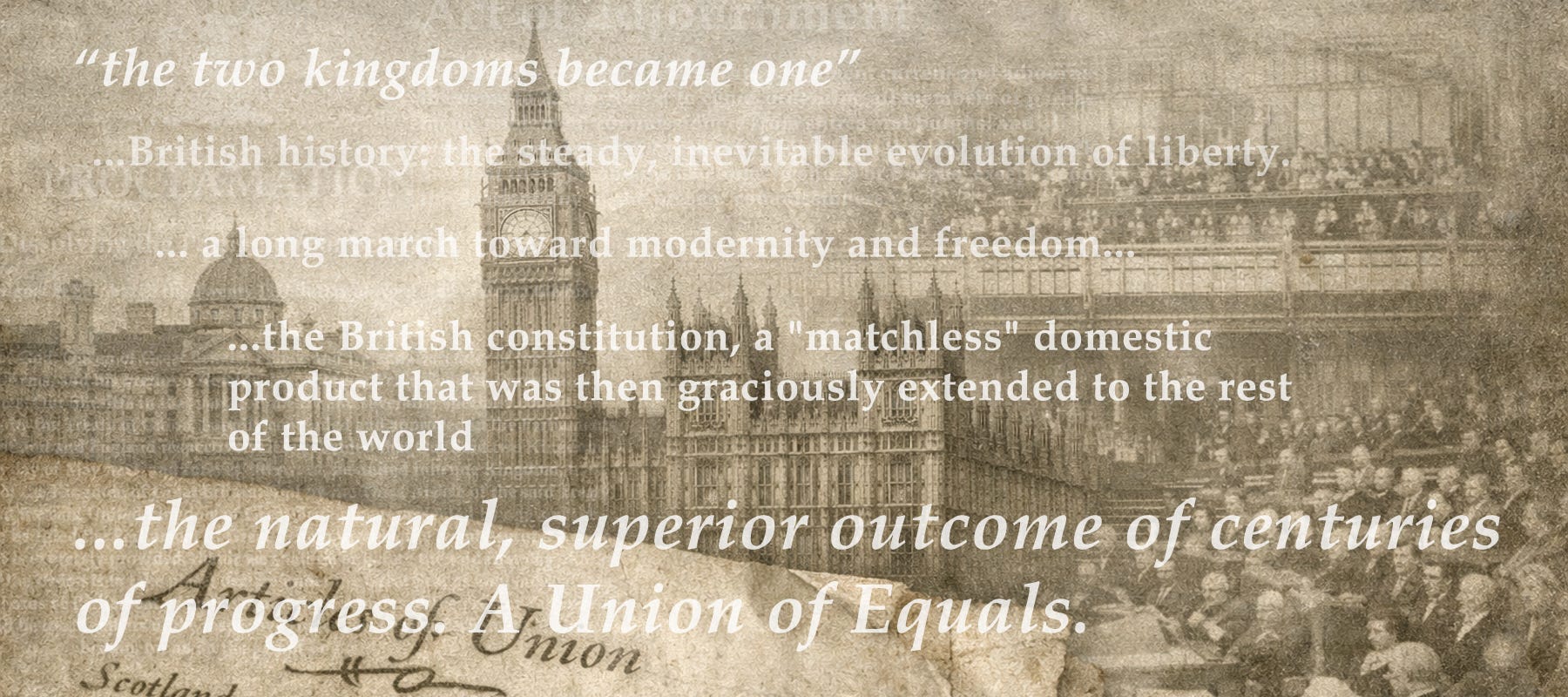
In the eighteenth century, writers could describe the post‑1707 settlement in loose, outcome‑focused terms without anxiety. Phrases like “the two kingdoms became one” or “the former states ceased” functioned descriptively. They didn’t attempt to explain how sovereignty ended or by what authority institutions were extinguished. In an early‑modern world of dynastic politics and elite bargains, that level of explanation was often considered sufficient.
What changed incrementally wasn’t the events of 1707 themselves, what changed was the intellectual environment interpreting it.
By the nineteenth century, Anglo-British political thought increasingly presented itself as liberal, constitutional, and progressive. The state’s legitimacy increasingly rested on consent, representation, and the moral authority of Parliament. Within that framework, the annexation of a neighbouring European nation became awkward, and difficult to justify because it sat badly with a self‑image built around liberty and lawful evolution.
The response wasn’t to revisit the evidence and reconsider the facts, the response was to recode the language. So descriptive shorthand hardened into doctrinal claims. The outcome was that hard facts, like the Scottish Parliament was dissolved, were quietly transformed into legitinate constitutional mechanisms. So, for example, “there is one state” became “both states dissolved by consent”. The words stayed similar but their actual meaning, and the consensus understanding of that meaning, changed.
Whig historiography
This recoding was carried by a group of Historians who are collectively known as Whig Historians, after the 19th Century political party, whose historians (like Thomas Babington Macaulay) often wrote patriotic narratives celebrating the triumph of Parliament over the absolute power of kings. The term was popularized by British historian Herbert Butterfield in his 1931 book, The Whig Interpretation of History.
Whig Historians shared a common set of assumptions about how history should read:
political development is progressive and rational;
Parliament Westminster) embodies the will of the people;
constitutional change is evolutionary, not coercive;
outcomes are legitimised by endurance.
In Whig Historiography, the Union is therefore treated less as an event requiring explanation than as a stage in a long march toward modernity. Moments of coercion, asymmetry, or exclusion are dissolved into inevitability. Parliamentary ratification is taken as proof not just of legality, but of constituent authority (the ultimate power to create or fundamentally alter a constitution, originating from the people as the source of sovereignty) because the English model of Crown-in-Parliament constitutional supremacy is taken as natural by default.
So historians like Thomas Babington Macaulay and, Henry Hallam presented British history as a steady, inevitable evolution of liberty dating back to Anglo-Saxon “folk-moots”. This established a “pedigree” for the English nation which suggesting that modern English/British) parliamentary democracy was the natural, superior outcome of centuries of progress.
This narrative was essentially written by and for the successful specifically, wealthy, Anglican, English elites. It frequently sidelined or dismissed “lost causes” and marginalized groups, including Catholics, the working class, the Scots, and radicals like the Ranters, who didnʼt fit the story of peaceful constitutional progress. For example, by framing the 1688 Glorious Revolution and the rise of Parliament as the ultimate “triumph of good over bad,” Whig history provided a moral justification for the British Empire and the Victorian status quo. It portrayed the British constitution as a “matchless” domestic product that was then graciously extended to the rest of the world.
What disappears in this narrative is any institutional analysis or question of where power and sovereignty lay. So questions like which sovereignty ended, which institutions continued, or where constituent power actually resided are treated as pedantic or unnecessary. The narrative doesn’t need them, because legitimacy is assumed to flow from Parliament itself.
Those assumptions therefore did most of the work.
Parliamentary myth‑making
A crucial move in this process was the elevation of parliamentary ratification into a definitive act. Two parliaments passed Acts approving the Treaty; therefore, the states dissolved. Evidence to the contrary is rendered irrelevant.
This isn’t a legal or constitutional argument so much as a cultural reflex. British constitutional thought, much like Whig Historiography, had long treated Parliament as a moral engine rather than merely as a legislature, the place where law, consent, and legitimacy converge. Therefore once Parliament had spoken, further inquiry feelt improper, even destabilising. It’s this reflex we still often see when we ask questions about what actually happened in 1707.
The difficulty, as already shown elsewhere, is that legislative supremacy wasn’t the same thing as constituent authority in Scotland. Parliamentary ratification wasnʼt a substitute for lawful abolition. An Act saying two states had ended didnʼt make it so if the sovereign institutions of one state continue unchanged.
But within the Whig frame, the distinction rarely matters. Parliamentary declaration simply becomes historical fact by repetition.
Elite continuity and incentive
Another reason annexation was easy to obscure is that 1707 didn’t require wholesale elite displacement. Scottish elites were incorporated, not replaced initially. Those who resisted, most notably in 1715, and 1745, were either removed or forced into compliance. The important feature is there was no single moment of mass displacement, and where displacement was partially apparent the event was re-narrated as a mistaken, backward-looking argument about monarchy or religion where modernisation necessitated displacement. However for the cooperative and the compliant rewards, patronage, access to imperial office, military command, and commercial opportunity followed swiftly.
This was important because when it’s apparent that colonial rule replaces local elites, resistance narratives tend to persist. Where elites are largely absorbed, legitimacy myths are more likely to stabilise. Over time, defending the founding story becomes aligned with defending one’s own institutional inheritance.
That doesn’t even require bad faith, all it requires are incentives.
Authority substitution as culture
By the time modern constitutional law emerged, the annexation question was no longer debated; it was closed. So when the issue is reopened, it triggers predictable responses:
appeal to canonical jurists;
appeal to court statements;
appeal to settled understanding.
These moves don’t engage evidence, they simply signal where inquiry must stop.
This type of authority substitution isn’t unique to Unionism, authority substitution is a general feature of systems defending a legitimacy gap, it’s a defensive reaction. Where constituent power cannot be demonstrated, authority takes its place.
This cultural habit explains why annexation analysis often feels like it’s being rejected out-of-hand. It’s not being weighed and rejected on its own merits as an evidenced argument; it’s being screened out as inadmissible because it cannot be weighed and rejected on its own merits because it is too much of a threat to the existing narrative.
What this explains — and what it sets up
Seen this way, the long suppression of annexation as an explanation of 1707 isn’t a mystery any longer. It’s clearly the product of:
a shift from descriptive language to doctrinal myth;
a historiography that treated Parliament as morally constitutive;
elite incorporation that removed internal challengers;
and a resultant culture of authority that still closes down inquiry rather than resolving it.
Understanding these mechanisms matters because they are still active. They don’t just explain the past; they shape present behaviour.
Which raises the next question:
If annexation was normalised historically, how is it still defended today — and why does evidence rarely change the response?
And that’s where our analysis turns next time.

Next: How The Annexation Of Scotland Is Still Defended

If you’d like to support my research into Scotland’s true history, you can chip in for running costs (and the coffees that keep me going) here: https://ko-fi.com/angrypict
Throughout the whole 300+ years of narrative , explanation and insistence the rebellion and outrage at the time of normal everyday Scots against this abomination barely merits a mention and even if it does it is explained away by the mention that normal everyday Scots had no voting rights or were beholden to their superior elites , therefore they did not count
The oft quoted risings of 1715 and 1745 (not to mentiin, for example, 1711) were after 1707, but officially sanctioned attacks like in Glencoe show that the post-1689 settlement itself was unstable. In practice, the English/Scots-speaking minority, feeling embattled (as effectively an ethnically colonial culture) backed the legal establishment in Scotland to suppress and eventually all but wipe out Gàidhlig-speaking Scotland. The attacks were legal, as in the order from Edinburgh to slaughter the inhabitants of Glencoe in their beds; cultural in the deliberate crushing of the time-honoured custom of hospitality (some soldiers were even related to the victims with whom they were billeted); and, of course, linguistic. To this day, supporters of constitutional Unionism (including nominal Scottish Nationalists) claim that Scotland exists within the Union - another way to deny the colonial context.