
The Rule, Not the Exception
You don't need to break a rule if you build the system so the rule can't be kept.

Previously: No New State, In 1707 no new parliament was summoned, no new state was born, and the one condition the Union was built to protect was destroyed within a year.
The last piece showed the Union was never validly formed, and that it was breached within a year. This one asks whether that breach was an accident. It wasn’t. It was the first instance of a clear method — and that method is still running.
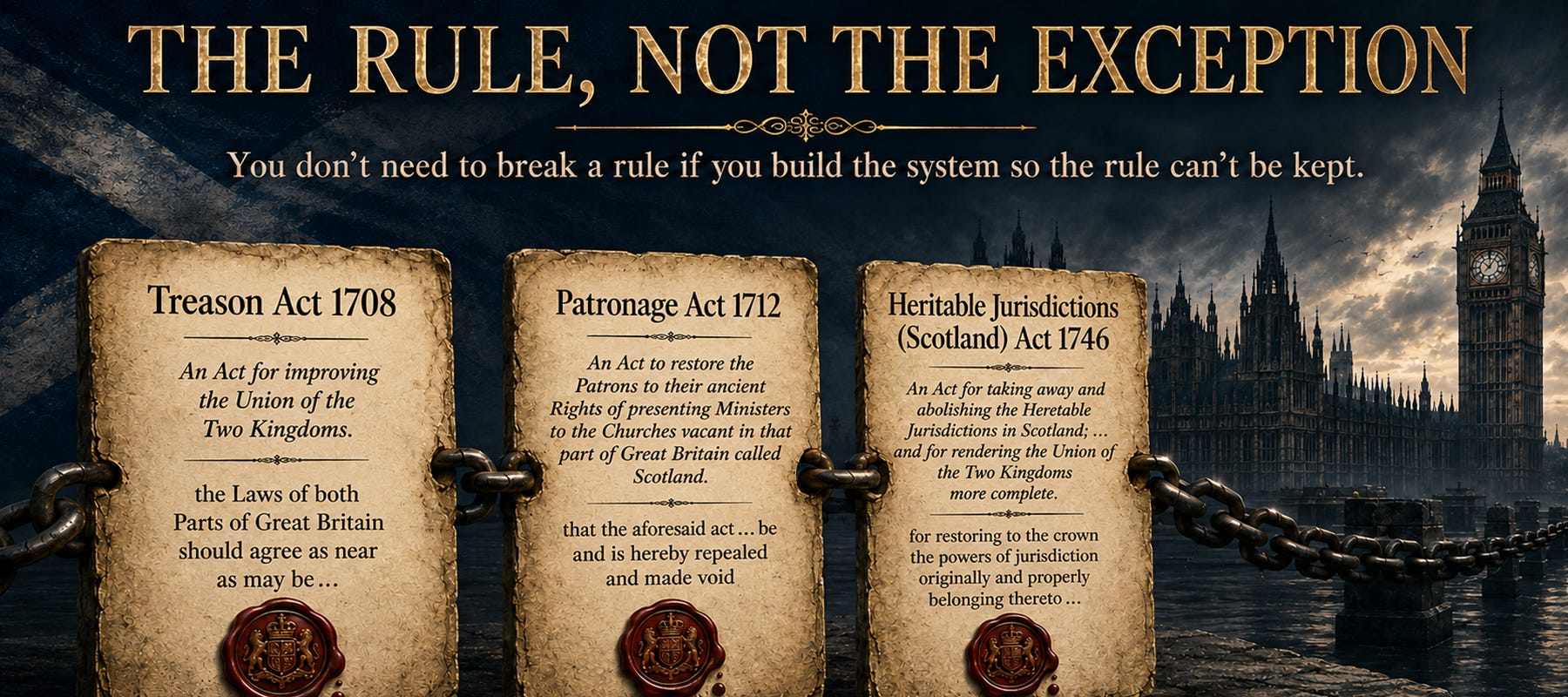
Read on its own, the Treason Act of 1708 looks like a single early lapse: a treaty barely signed, a protection quickly ignored, the sort of thing that happens once and is corrected. The last piece left it there deliberately, because the question it raises is the one that matters. Was that breach an aberration — an overreach the system later thought better of? Or was it the first move in a pattern?
It was the pattern. What follows it is the same operation performed again and again, in different registers, for three centuries, each time licensed by a doctrine that was not present when the Union was made.
The same move, repeated
Start with what the 1708 Act actually did, because it sets the template. Article XVIII left the new Parliament free to alter Scots public law, and treason is public law — so the Act was within the Treaty’s letter. What it was not within was the basis on which Scotland had ratified. Within a year, the Treason Act abolished Scots treason law entirely and substituted the English definition, striking directly at the constitutional settlement Scotland had made the declared condition of its assent. The preamble called this “improving the Union” and making the laws “agree as near as may be.” Nothing was harmonised. One system was eliminated and the other installed. The language of tidying-up did the work of replacement. That pairing — an override in substance, an administrative gloss on the surface — is the move. Watch it recur.
By 1712 the Patronage Act had restored lay patronage in the Church of Scotland — overriding, by legislative will, the very settlement the ratifying Act had declared perpetual. In 1746 the Heritable Jurisdictions Act removed protected Scottish jurisdictions — a breach so plain that even Swiss Jurist and Constitutional expert De Lolme, writing to praise the Union, conceded it. Different domains each time: criminal law, then the church, then the courts. The same operation: a preserved sphere, declared safe, quietly overridden by the stronger party, with the treaty’s own guarantees treated not as binding limits but as obstacles to be managed.
The breach that needed no act
The deepest version of the method didn’t require an overriding statute at all. This is the part that turns a list of violations into a description of how the thing was built.
Article 19 of the Treaty preserved the distinct Scottish legal system. The test of a preserved legal system isn’t whether it appears in a statute book; it is whether the court that applies it is staffed by people trained in it. As Professor Robert Black KC set out at the Palais des Nations in Geneva in September 2025: from 1707 to 1867 — a hundred and sixty years — not one judge trained in Scots law sat in the final court of appeal for Scottish cases. The institution charged with protecting Scots law was, for a century and a half, incapable of doing so, because it was staffed by men trained in the other system.
The men themselves said as much. Lord Cranworth, hearing a Scottish appeal in 1858, asked why, if a rule was the law of England, it should not also be the law of Scotland — “the law as established in England is founded on principles of universal application.” That is English law announced as the default, from which Scots law must justify any departure: the exact inversion of what Article 19 preserved. Lord Erskine, from the same bench, admitted he was of Scots law “as ignorant as a native of Mexico.” These are admissions from inside the institution supposedly protecting the thing being lost.
That is the method at its purest. The Treaty wasn’t breached here by a series of open violations that a court could point to and strike down. It was breached by an institutional arrangement that made violation the ordinary, unremarkable outcome — that built the machinery so the protected law could not be given its own effect in the first place. You don’t need to break a rule if you construct the system so the rule can never be kept.
The licence
Each override needs a justification, and the justification is always the same: Westminster is supreme; the United Kingdom is a unitary state; the centre may legislate for the whole and no preserved Scottish term can finally bind it. Grant that, and every breach becomes lawful by definition — not a breach at all, merely the supreme legislature doing what a supreme legislature does.
But that doctrine was never the founding logic of 1707. As the “no new state” argument showed, the mature theory of unlimited, centralised parliamentary supremacy developed progressively and was then read backwards onto a settlement that didn’t originally rest on it. The Union was presented as a bilateral arrangement with protected spheres and perpetual conditions. The doctrine that licenses treating those conditions as disposable came later and was projected onto the founding after the fact. So the justification for three centuries of override is itself retrofitted: the breaches are defended by a rule that wasn’t in force when the promises were made.
And a protection with no authority above the centre capable of enforcing it isn’t, in the end, a protection. It is permission. It survives exactly as long as the stronger party finds it convenient, and no longer. Treaty guarantees that bind only the weaker signatory, and never the stronger, are guarantees in form and grace in substance.
Still running
The register keeps changing. In the first phase the instrument was military and legal — garrisons, disarming acts, the abolition of a legal tradition. Later it became administrative and economic. In the current phase it is political, and the outward form is scrupulously lawful. But the outcome the mechanism produces never changed: decisions imposed on Scotland without, or against, its expressed consent. The poll tax imposed a year ahead of England on a country that hadn’t voted for it. The statutory veto used to strike down legislation passed by the Scottish Parliament. The ruling that Scotland can’t lawfully ask itself the constitutional question without Westminster permission. Each is defended, correctly, as within the law — because the law is the doctrine that was retrofitted to make the overriding lawful in the first place. Domestic legality isn’t the answer to the charge. Legality is the mechanism of the charge.
One breach is a violation. A breach in 1708, another in 1712, another in 1746, an entire court built for a century and a half so the protected law couldn’t be applied, and the same override continuing into the present in a lawful-looking form — that’s not a series of accidents. It is a method, and it has never stopped.
This is why the argument doesn’t close in the eighteenth century, why it’s not ‘just history’. A completed historical wrong is one thing; a grievance, however justified, that belongs to the past. A wrong still being committed is another order of claim entirely. The overriding of Scotland’s preserved sovereignty wasn’t a founding-era episode that later settled down and ended. It is a continuing practice, licensed by a doctrine invented to license it, running to the present day. And a continuing wrong is answerable now — not merely remembered.
Next: Two Crowns, Not One (Wednesday 19 August) — The story that 1707 merely finished what 1603 began rests on a single claim: that the crowns were united when James inherited both thrones. They were not. The two crowns were different kinds of thing — and you cannot unite what is not the same kind of thing.


If you’d like to support my research into Scotland’s true history, you can chip in for running costs (and the coffees that keep me going) here: https://ko-fi.com/angrypict
Sorry 🤦♂️, Ireland some useless treaty which they never had any intention of upholding. Wales Ireland and Scotland were the testing ground for future colonial lands
Many thanks for unraveling the particular acts that demonstrate this pattern of behaviour by England disregarding Scots law.No doubt this had originally been tried out in Irela